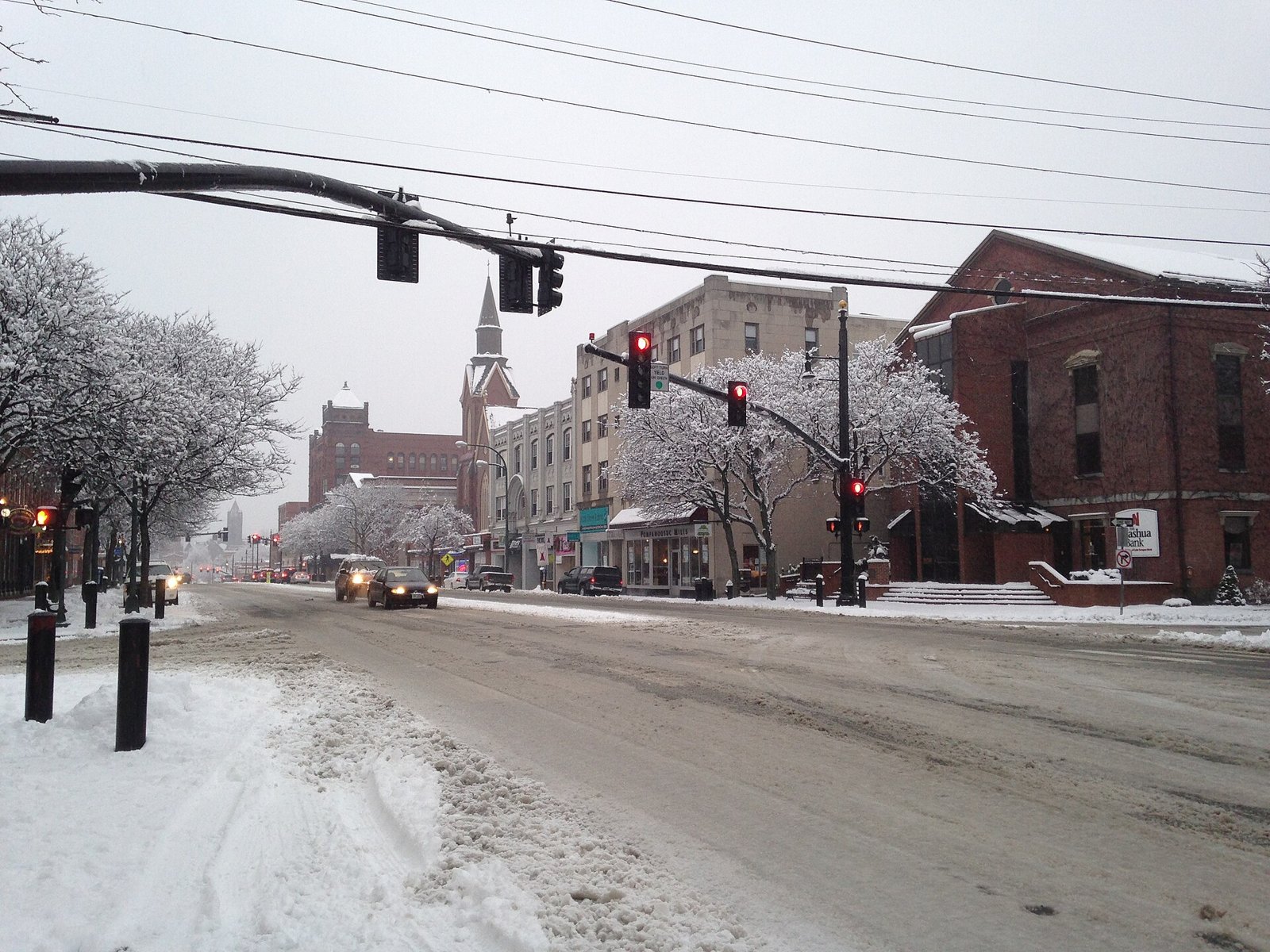
Southern New Hampshire gets more snow than Boston, but not a different planet’s worth. What catches people off guard is the driveway, the parking rules and the furnace.
Winter in southern New Hampshire is colder and snowier than Boston’s, but not by as much as people expect. Under NOAA’s 1991–2020 climate normals, Concord averages about sixty-eight inches of snow a year and Boston about forty-nine. The average temperature from December through February is roughly twenty-five degrees in Concord, twenty-eight in Manchester and thirty-two and a half at Logan. That’s a real difference. It isn’t the thing that makes or breaks living here. What does is the small stuff nobody mentions until the first storm: who clears the driveway, where the car sleeps, what the house heats with, and how far you drive to work.
How it compares with Boston
Most of that extra snow lands in the same three months. NOAA’s normals put Concord at a little over forty-eight inches for December through February, against about thirty-eight in Boston. Concord is north of most of the towns on this site, so treat its numbers as a benchmark, not a forecast for your street. Manchester’s airport station doesn’t publish a snowfall normal at all.
So if you’ve lived a few Boston winters, you already know the drill. You’ll just do it a few more times a year, and with colder averages, the snow tends to stick around longer before it melts.
What actually changes day to day
The driveway is yours
In most towns, the road crew plows the street and you handle everything off it, including the bank the plow leaves across the end of your driveway. Some people buy a snowblower the first fall, some hire a plow service, and some do both after the first big storm. If you’re looking at a house with a long or steep driveway, find out what the current owner does and roughly what it costs. Don’t solve it by pushing snow back into the road. In Manchester, that’s against city ordinance, and it’s worth checking your own town’s rule.
Where the car sleeps matters in the cities
The two biggest cities each have their own rules, and they’re different. Manchester runs an overnight winter parking rule from December 1 to April 15: between one and six in the morning, you park only on the side of the street that matches the month, odd or even. December is the even side. When the city declares a snow emergency, nobody parks on the street at all, and towed cars cost two hundred dollars in cash to get back, before any fine.
Nashua limits overnight street parking all year under its city ordinance: between midnight and six, no more than two hours on a public street without a permit. During a declared snow emergency, every car has to come off the street, the fine starts at at least a hundred dollars, and the city opens the High Street and Elm Street garages and the 25 Crown Street lot for free. Not every storm is an emergency, so sign up for the city’s alerts.
If you’re buying a condo, a two-family or anything without a real driveway in either city, ask where the cars go in February. Smaller towns have their own ordinances, so check with the town office. Each of our town guides lists it.
Clean off the whole car
New Hampshire drivers get ticketed for driving with snow and ice on the roof. As the New Hampshire Law Library explains, the law people call Jessica’s Law is RSA 265:79-b, the negligent driving statute, passed in 2001 after a young woman was killed by ice that flew off a truck. The statute doesn’t mention snow at all, but it’s what you’ll be cited under. A first offense runs two hundred fifty to five hundred dollars. Buy a long snow brush.
Buying a house with winter in mind
A showing in May tells you very little about January. A few things worth asking about on any house, before you write an offer:
- What it heats with, and what that costs. Ask for a year of heating bills or fuel delivery records. If there’s an oil or propane tank, find out its age and who delivers.
- The roof and gutters. Ask whether there’s ever been an ice dam or a winter leak, and look for staining on the ceilings under the eaves. A home inspector can tell you a lot here.
- Power outages. Ask how often the power goes out and for how long, and whether the house has a generator or a transfer switch. In a house with a well, no power usually means no water, too.
- The driveway. Length, slope, which way it faces, and whether it’s shared. A shared driveway should come with a written agreement about plowing.
If the house has a well, the rest of what to check is in our post on wells and septic systems. When you’re browsing listings on search.crestresi.com, it’s worth noticing which ones were photographed in winter. You get a better sense of where the snow goes.
The commute is the real variable
A storm that’s an annoyance in town can turn a forty-minute drive into ninety. That’s the part of winter that actually wears on people, and it depends far more on the route than on the town. If you’re keeping a job in Massachusetts, the commuting section of our guide to moving from Massachusetts goes through the options, and our post on what people don’t tell you about living here covers how map distance and drive time come apart. Drive the route on a bad morning before you buy, if you can. If you fly for work, our page on Manchester-Boston Regional Airport has drive times from the area.
What people end up liking about it
This is the part that doesn’t show up in the climate tables. Winter here is quiet. The towns don’t shut down, the roads get plowed, and the days after a storm are often bright and cold and very pretty. Manchester even runs its own small ski area, McIntyre, inside city limits. Out in the hill towns like Peterborough and Hillsborough, a snowy morning mostly means a slower drive into town and a good excuse to stay in.
People who struggle with winter here usually didn’t plan for the logistics. People who plan for the logistics mostly just get on with it. I’m licensed in New Hampshire and Massachusetts, and I’m happy to talk through any of this for a specific house or town.
Frequently asked questions
NOAA’s 1991–2020 normals put Concord at about sixty-eight inches of snow a year, compared with about forty-nine at Boston’s Logan Airport. Most of it falls from December through February. Concord is north of most southern New Hampshire towns, so treat it as a benchmark.
In most towns, no. The town plows the public road and the homeowner clears the driveway, including the bank the plow leaves at the end. Many towns, including Manchester, don’t allow you to push that snow back into the street.
Manchester has an odd and even overnight parking ban from December 1 to April 15, between one and six in the morning, and no street parking during a declared snow emergency. Nashua limits overnight street parking all year, with no more than two hours between midnight and six without a permit, and every car must come off the street during a declared snow emergency.
Yes. Drivers who don’t clear snow and ice can be cited under RSA 265:79-b, the negligent driving statute known as Jessica’s Law. A first offense carries a fine of two hundred fifty to five hundred dollars.