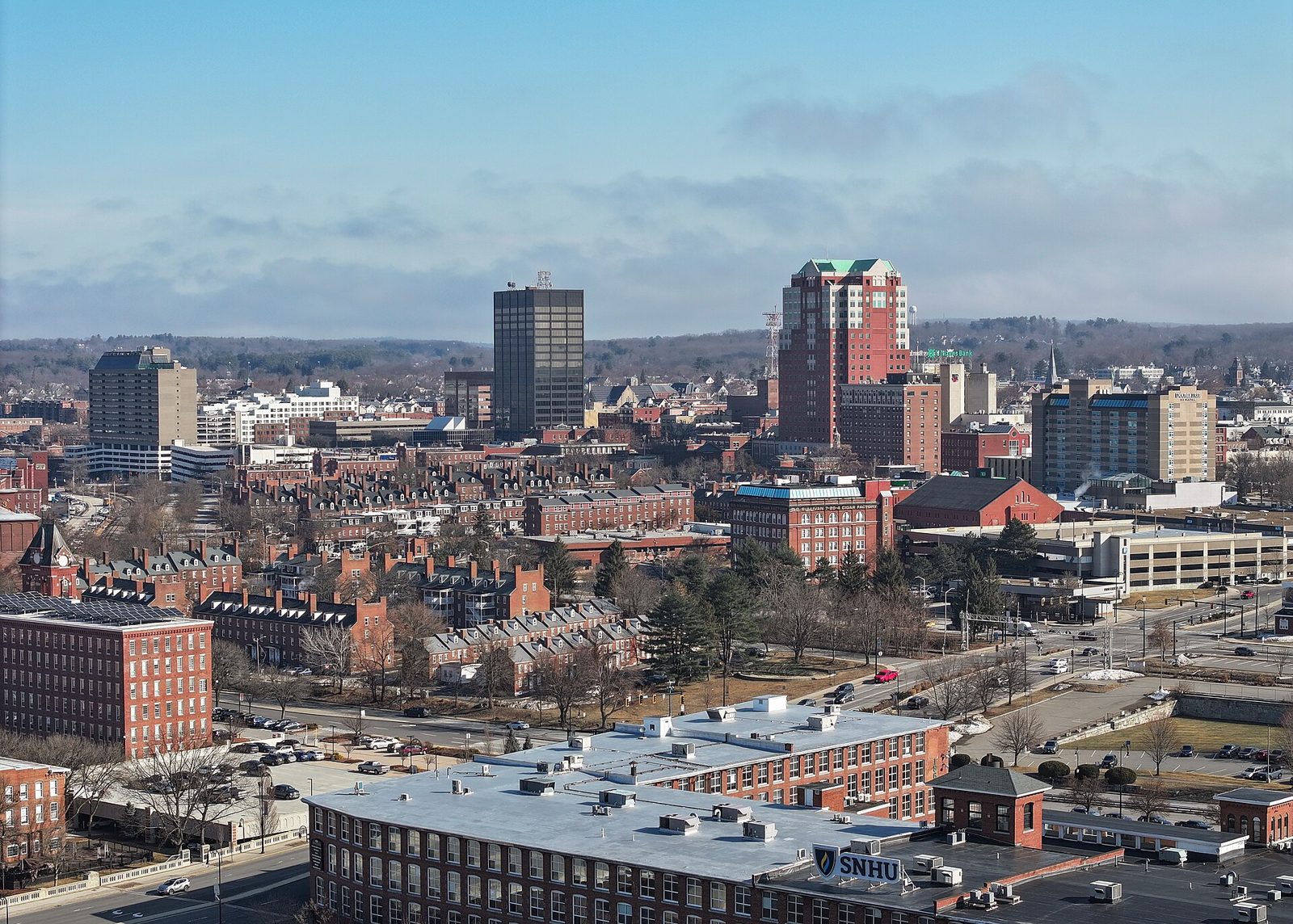
Manchester is the largest city in New Hampshire, with 115,644 people at the 2020 census. It has a downtown skyline, a minor league ballpark, an arena and the regional airport, all within a few miles of each other.
Where it is and getting around
Manchester sits on the Merrimack River, about 18 miles south of Concord and the same distance north of Nashua. Bedford is the next town west, across the river. To the northwest, the Pinardville part of Goffstown runs right into the city. I-93 and I-293 both run through the city, along with US Route 3 and a handful of state routes, including 3A, 28, 101 and 114A. Manchester-Boston Regional Airport is on the Manchester-Londonderry line. The Manchester Transit Authority runs local buses and Zip Line express routes to Concord, Nashua and Salem.
Drive times without traffic, from the center of town:
- Manchester-Boston Regional Airport: about 15 minutes
- Concord: about 25 minutes
- Nashua: about 30 minutes
- Portsmouth: about an hour
- Boston: about an hour and 10 minutes
Those are from a routing tool with no traffic. I-93 south toward Boston is the drive to test at your actual commute time.
Derry is about 20 minutes southeast on I-93.
There is also a long-standing proposal to extend MBTA commuter rail from Lowell up to Manchester, with a station planned behind the Market Basket on Elm Street. It’s still a proposal, not a schedule.
What it’s like
Manchester was built around one enormous mill company. The Amoskeag Manufacturing Company, at Amoskeag Falls, became the largest cotton textile plant in the world. Its engineers laid out a planned company town on the east bank in 1838, with Elm Street as the main road, and Manchester became a city in 1846. Many of the mill workers were immigrants, particularly French Canadians. Textile jobs left after World War II. The Millyard Museum is in the old mill buildings along the river now, and the inventor Dean Kamen owns several of them.
Downtown has the Palace Theatre, the SNHU Arena, and the ballpark on the river where the New Hampshire Fisher Cats, the Toronto Blue Jays’ AA team, play. The city also has the Currier Museum of Art. Massabesic Lake is on the city’s eastern edge, with the Massabesic Audubon Center nearby. The Mall of New Hampshire on South Willow Street is the city’s main retail area.
Manchester is also where New Hampshire’s VA hospital is, the Manchester VA Medical Center on Smyth Road. VA’s regional benefit office and the state Division of Veterans Services are both downtown at 275 Chestnut Street. There’s a separate veterans resource guide that covers them, with addresses, phone numbers and where to start.
Housing and neighborhoods
The city’s 2010 master plan defines 25 neighborhoods. The older ones include Amoskeag, Rimmon Heights, Notre Dame and Piscataquog (“Piscat”) on the West Side, and the North End, Janeville, Hallsville and Bakersville on the East Side. Youngsville and Goffes Falls are out on the edges. As the city grew in the late 1800s and early 1900s, streetcar suburbs like the Mast Road area went up.
Drive the specific streets you’re considering at a few different times of day before you decide.
Property taxes
Manchester’s current tax rate is $20.24 per $1,000 of assessed value. The city lists it as the 2025 rate: $10.04 municipal, $7.33 local education, $1.51 state education and $1.36 county. As of November 10, 2026, the city said the 2026 ratio had not been set yet. (City of Manchester Tax Rates) The city charter also has a tax cap that limits how much total money the city can raise from property taxes each year.
To compare towns fairly, use the state’s full value tax rate, which I explain in How property taxes affect what you can afford. It adjusts for how close each town’s assessments are to market value. The NH Department of Revenue Administration puts Manchester’s 2025 full value rate at $12.95 per $1,000, with an equalization ratio of 64.7%. (NH DRA Equalization; figures from the DRA 2026 Annual Report)
Schools
Manchester’s public schools are run by the Manchester School District, SAU 37. The elementary schools are Bakersville, Beech Street, Gossler Park, Green Acres, Highland-Goffe’s Falls, Jewett Street, McDonough, Northwest, Parker-Varney, Smyth Road, Webster and Weston. The district also lists Preschool & Child Find. The middle schools are Hillside Middle School, McLaughlin Middle School, the Middle School at Parkside and Southside Middle School. The high schools are Manchester High School Central, Manchester Memorial High School, the Manchester School of Technology and Manchester High School West. The district also lists Manchester Adult Education. (Manchester School District)
School assignment depends on the address, and the district has a Find My School lookup for that.
If schools are part of your decision, there’s a separate guide on how to research schools when you’re buying a home, starting with confirming an address with the district.
City services and links
- City of Manchester, City Hall at One City Hall Plaza. City Clerk: 603-624-6455
- Trash and recycling: the city picks up trash curbside in a green city cart and recycling in a blue cart. Carts go out by 7 a.m. on your collection day. If you’ve just moved in, collection starts automatically. Trash and recycling questions: 603-624-6444.
- Drop-Off Facility at 500 Dunbarton Road, 603-624-6504: Monday to Friday 7:30 to 3, plus the first and third Saturdays of the month 7:30 to 1.
- Assessors and tax rates
- Winter: Manchester runs an odd and even overnight parking ban from December 1 to April 15, and no one parks on the street during a declared snow emergency. Our post on winter in southern New Hampshire has the details.
Homes for sale in Manchester
You can browse everything currently listed in Manchester, with maps and photos, on my home search site.
Manchester FAQ
Manchester is about 53 miles from Boston by car. Without traffic the drive is about an hour and 10 minutes.
The city’s current rate, listed as the 2025 rate, is $20.24 per $1,000 of assessed value. The state’s 2025 full value rate for Manchester is $12.95, because assessments there run well below market value.
Manchester has its own district, the Manchester School District (SAU 37). The elementary schools are Bakersville, Beech Street, Gossler Park, Green Acres, Highland-Goffe’s Falls, Jewett Street, McDonough, Northwest, Parker-Varney, Smyth Road, Webster and Weston. The middle schools are Hillside Middle School, McLaughlin Middle School, the Middle School at Parkside and Southside Middle School. The high schools are Manchester High School Central, Manchester Memorial High School, the Manchester School of Technology and Manchester High School West. School assignment depends on the address.
Yes. The city collects trash and recycling curbside in city carts, and there’s a drop-off facility at 500 Dunbarton Road for extra items.